

For quality and risk leaders
A defensible, contemporaneous record of every update.
Risk, and proof of care. "NOK informed" with no content means long investigations and nurse interviews.
Written for: Head of Quality, Head of Risk, Clinical Governance, Quality and Compliance, Director of Clinical Services
- Risk mitigation
- Proof of care
- Strengthened Standards
- Consistency across homes
What Brenna means for you
Four things, in your language.
If it's not documented, it didn't happen.
A defensible, contemporaneous record of every update, saved to the clinical record.
A clear audit trail that's quick to find. Fewer complaints follow.
Clinical record integrationNo more "NOK informed" with nothing behind it.
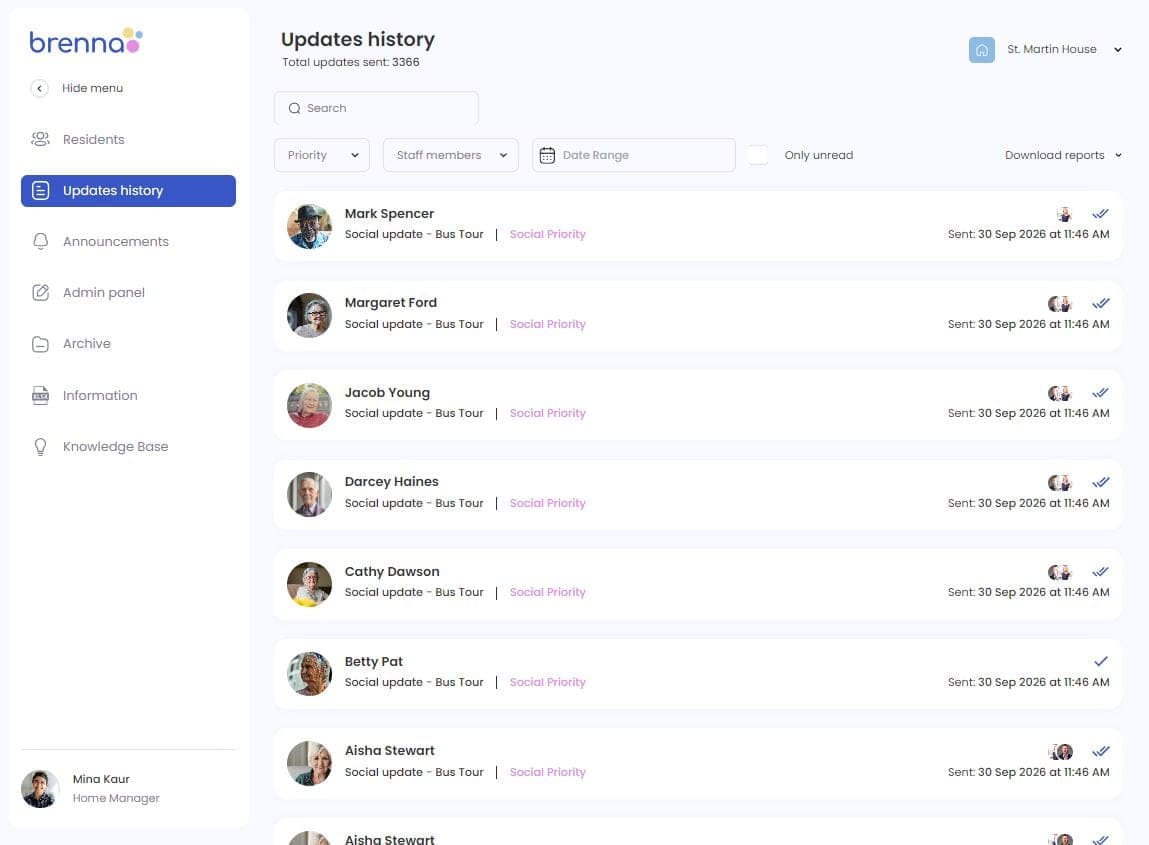
The full content of every update, timestamped and read-tracked.
No long investigations or nurse interviews to rebuild what was said.
Read receipts and automatic follow-upThe same standard every shift, on the record.
One guided process, timestamped and read-tracked.
What was said, when and to whom, retrievable in seconds, six weeks later.
Update history and oversightHours returned to care.
20 to 30 minutes per nurse per shift.
Clinical capacity back on the floor, without hiring.
Proof: 385,000+ individual family updates, each one in the clinical record.
Proof
What quality and risk leaders and their teams tell us.
Clearer communication for a diverse team
Annie Thompson, General Manager
Good Shepherd Lodge
Documentation that takes care of itself
Kulwinder, Registered Nurse
Greenhill Aged Care
The update history in Brenna is great. I was never able to know what had or hadn't been communicated before, and now I can pop in and check it whenever I want during the day and prompt one of my nurses if I need to. I can proactively fix things instead of sorting out problems later on.
It really helps our culturally diverse team. The staff are really happy we implemented Brenna.
Brenna protects the staff and nothing slips through the gaps.
The traffic light helps family know how serious the update is. It's very structured and straightforward.
Common questions
The things you will be asked internally.
The Standards require documented communication and consultation with representatives. It isn't enough that it happened; it has to be on the record. Brenna records every update, who received it, when it was read, what reminders went out and whether follow-up occurred, and writes it to the clinical record.
Consent requests are sent and tracked through the same workflow, so the evidence of consent sits with the rest of the record.
No. The update is the documentation. It becomes a progress note automatically, which removes the end-of-shift write-up that is so often delayed or missed.
Bring a recent complaint or audit finding.
We will show you what the record would have looked like.
Also written for